

Stationary Oven Carousel Rotomolding Machine: China’s Manufacturing Expertise and Key Advantages
2026-10-12
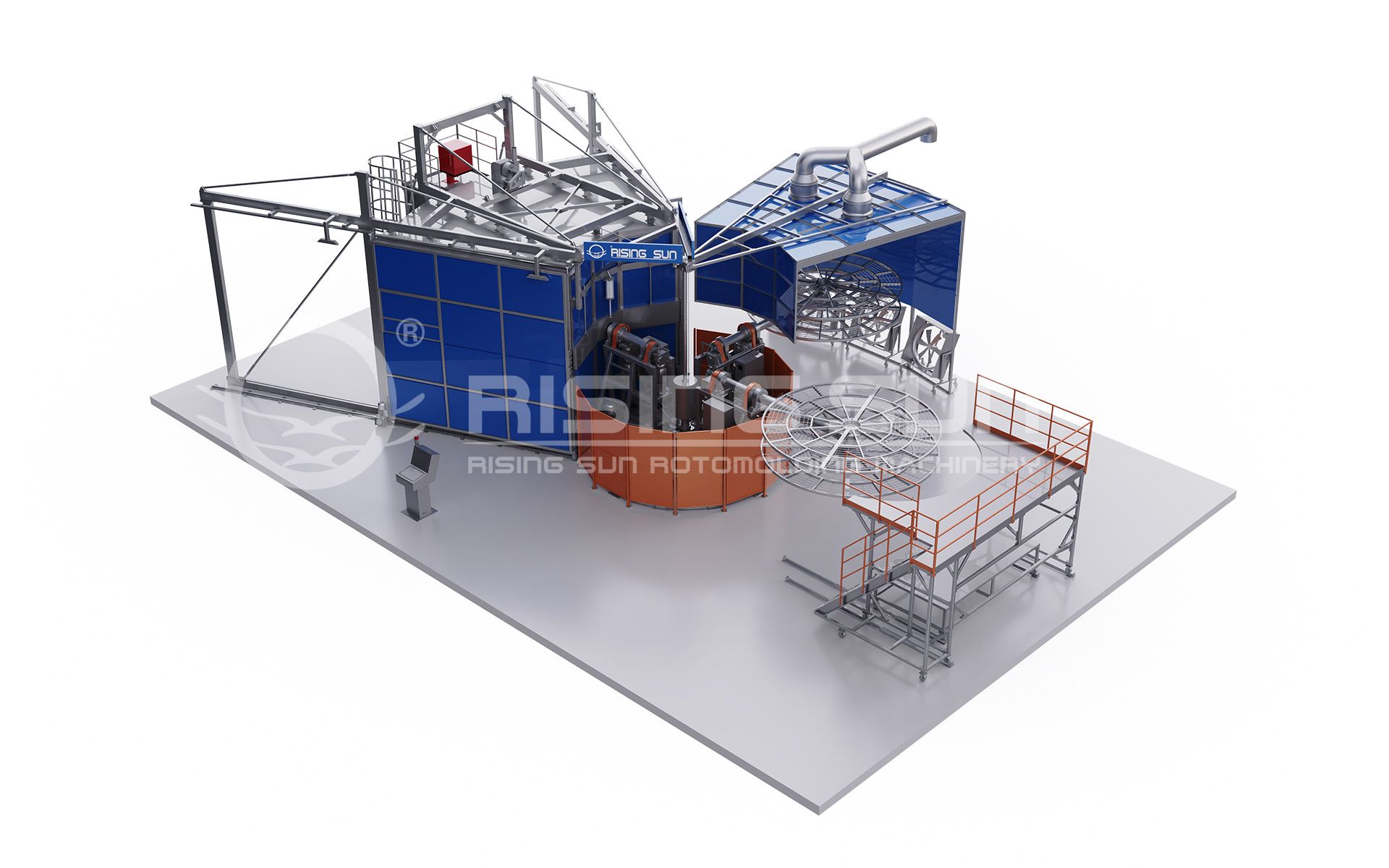
Rotomolding has quietly revolutionized how we produce large, hollow plastic parts—from storage tanks to playground equipment. Among the various machine types, the stationary oven carousel design stands out for its efficiency and consistency. China, now a global leader in rotomolding machinery, has refined this technology to an impressive degree. Rising Sun is one of the manufacturers driving that progress, combining precision engineering with cost-effective production. If you're evaluating equipment for your next project, understanding the stationary oven carousel's key advantages is essential. Let's dive into what makes this machine a smart choice for modern manufacturing.
Carousel Geometry Meets Stationary Heat: A Different Rotomolding Workflow
Most rotomolding setups spin the mold through an oven, chasing heat as it moves. This workflow flips that logic: the mold stays put while a carousel of radiant panels orbits around it. The result is a stationary thermal field with geometry-driven exposure, not a moving part guessing at temperature gradients.
Because the part never leaves the heating zone, wall thickness becomes a function of panel dwell time rather than oven air temperature alone. Deep pockets and tight radii get their own pass schedule, letting the polymer fuse where it actually needs to, instead of where the rotation happens to carry it.
Tooling changes shrink to simple fixture swaps. No more rebalancing a full arm or recalibrating oven zones for each new shape. The carousel’s orbit radius and panel angle do the tuning, giving engineers a direct lever on local heat input without fighting the machine’s own motion.
Why Chinese Tooling and Steelwork Keep Tolerances Tight
The first thing that stands out in many Chinese tooling shops is the sheer density of measurement equipment. It is not unusual to see a row of CMMs, optical comparators, and laser scanners all running at once, often beside older manual gauges that still get used for quick checks. That mix of old and new is not for show. Shops learned years ago that if a dimension drifts by a few microns, the downstream assembly problems multiply fast, especially in automotive and consumer electronics contracts where batch sizes are huge.
There is also a structural reason for the tight tolerances. Many Chinese suppliers are vertically integrated to a degree that surprises first-time buyers. A single factory may handle die casting, CNC machining, surface finishing, and even final assembly under one roof. When one process feeds the next without a buffer of loose specs, every stage has to hold its numbers or scrap rates climb. So a tolerance of ±0.01 mm on a machined housing is not just a customer demand; it is a survival rule inside the plant.
Finally, the labor model plays a role. Veteran machinists in the Pearl River Delta and Yangtze River Delta often train on the job for a decade or more, and many of them can read a drawing and adjust a fixture as quickly as a programmer edits a toolpath. That hands-on skill, combined with rapid prototyping loops, allows shops to dial in a process until the variation almost disappears. What looks like an obsession with tight numbers is really a practical response to working at scale with thin margins.
Oven Insulation and Airflow Patterns That Most Buyers Overlook
While shopping for a new oven, most people focus on capacity, burner output, or smart features, yet few ever glance behind the oven's outer skin. The density and placement of insulation directly determine how evenly the cavity holds heat, and a surprisingly large number of mid-range models use thin fiberglass blankets that leave cold zones near the door gasket. A well-insulated oven not only reaches set temperature faster but also recovers more quickly after you open the door—something you only notice when roasting a large bird or baking multiple trays of cookies at once.
Airflow inside the cavity is just as critical, though it rarely appears on a spec sheet. True convection systems rely on a third heating element paired with a fan that pushes air through a baffle, but many ovens labeled "convection" simply stir existing hot air without directing it. This leads to uneven browning on sheet pans, especially when you load the racks fully. Look for a visible rear fan shroud with multiple vents and a rounded back wall—these physical details encourage a circular airflow pattern that carries heat to the corners instead of blasting the center.
Another overlooked detail is the exhaust pathway. Some ovens vent moisture and heat through a narrow channel above the door, which can warp cabinet edges over time or create a plume of steam that fogs nearby surfaces. Better designs route exhaust down toward the lower front or through a filtered rear vent, balancing humidity inside without scalding the user. If you bake bread regularly, that moisture management matters more than any touchscreen interface, because it controls crust development and prevents soggy bottoms on pies.
Arm Speed, Cooling Rate, and the Art of Avoiding Warpage
The relationship between arm speed and cooling rate isn't always obvious at first glance. In many injection molding cells, a robot arm extracts the part before it has fully stabilized thermally. If that arm accelerates too aggressively, it can impart bending moments to a part that is still soft in the thicker sections. Those sections tend to retain heat longer, so they yield more easily under sudden motion. A slower, more controlled extraction gives the part a few extra seconds to equalize temperature between thin and thick regions, reducing the internal stress that later shows up as warpage.
Cooling rate itself is rarely uniform across a molded part. Areas near the gate often run hotter, while ribs and bosses lose heat faster because of their higher surface-to-volume ratio. When a robot arm pulls the part out quickly and sets it on a flat surface, the side touching the surface cools at a different rate than the exposed side. This differential cooling can lock in a bow or twist that no amount of post-mold fixturing will fully correct. Slowing the arm just enough to prevent a hard stop, and using end-of-arm tooling that supports the part across its entire footprint, helps keep the geometry stable as the material passes through its glass transition.
There is an art to finding the right balance. Start by mapping the part's temperature profile at ejection using an infrared camera. Then adjust arm speed in small increments while recording flatness after 24 hours. Often a speed reduction of 10–15% will reduce warpage more than changing mold temperatures by several degrees. The key is to treat arm speed not as a cycle-time convenience but as a variable that directly influences the thermal history of the part during those first critical seconds outside the mold.
Common Production Bottlenecks Solved by Chinese Engineering Teams
When a production line stalls, the usual suspects are easy to name: slow manual assembly, inconsistent part quality, or a bottleneck at a single machine that forces everyone else to wait. Chinese engineering teams often tackle these issues with a mix of aggressive standardization and rapid prototyping. Instead of spending weeks in meetings, they will strip a process down to its essential steps, measure the time lost at each transfer point, and rebuild the workflow around the constraint. This hands-on, data-driven style means a bottleneck gets resolved in days rather than months.
Another common friction point is poor communication between upstream suppliers and downstream assembly. Rather than relying on complex ERP systems alone, many teams in China create visual pull systems with simple kanban cards or even WeChat groups that trigger immediate replenishment. This cuts down on overproduction while exposing hidden capacity problems. The key difference is that these teams treat the production floor as a living laboratory, adjusting layouts, fixtures, and labor allocation in real time based on what the bottleneck actually needs.
Finally, equipment downtime from changeovers is a frequent headache. Chinese engineering teams often build quick-release tooling and standardized setup carts so that a single operator can switch a line in under ten minutes. They also train operators to do basic maintenance and minor repairs themselves, reducing reliance on a separate maintenance crew. This approach doesn't just unclog the current bottleneck; it builds a culture where workers are expected to spot and solve constraints before they slow down the entire plant.
Cost Per Part Beyond the Purchase Price: Maintenance and Spare Parts Realities
A machine's sticker price rarely tells the whole story. Once equipment hits the floor, the real costs begin accumulating through routine upkeep, unexpected component failures, and the slow drip of consumables. Many buyers overlook that a low upfront quote often comes with higher long-term maintenance demands or proprietary spare parts that lock them into a single supplier's pricing.
Spare parts introduce their own hidden calculus. Holding too little inventory risks idle production lines while waiting for a single bearing or sensor, yet stocking every possible replacement ties up capital and shelf space. Lead times fluctuate, and parts that were standard yesterday can become scarce or discontinued tomorrow, forcing emergency orders at premium freight costs.
Smart teams shift their focus from initial cost to total cost of operation. They track mean time between failures, compare local supplier responsiveness, and evaluate whether aftermarket components offer genuine reliability or simply defer expenses. A part that costs twice as much upfront may prove cheaper if it lasts three times longer and reduces unplanned downtime.
FAQ
In a stationary oven, the heating chamber stays fixed while the arms rotate molds through it. This keeps the temperature profile stable because you are not opening and closing the oven between cycles. The heat source can be tuned once for a given material, and the insulation reduces cold spots that often appear in machines where the mold moves in and out of the heat zone.
Chinese builders have spent years refining steel fabrication and control integration for rotational molding. They often run in-house testing with real molds, which helps them understand how different wall thicknesses and materials behave. Because many component suppliers—bearings, gearboxes, burners, PLCs—are located close together, lead times and replacement part costs tend to be lower than in markets with fragmented supply chains.
The carousel gives you multiple stations around a central pivot, so one arm can be in the oven while another is cooling or being unloaded. That parallel workflow cuts idle time. For larger parts like tanks or playground equipment, the stationary oven can be sized to accommodate a full swing radius without the mold being moved across the factory floor, which reduces risk of damage or misalignment.
On well-built machines, yes. Each arm usually has its own drive motor and gearbox, so you can set different rotation ratios for different molds. The heating zones inside the oven may also be split into sections, allowing you to direct more heat to the bottom or side of a large mold. This level of control helps with parts that have deep draws or uneven wall requirements.
Ask to see test reports for oven temperature uniformity, preferably measured with thermocouples at multiple points. Request details on how the carousel bearings are sealed and lubricated, since that affects long-term reliability. A good supplier will also share videos of the machine running a mold similar to the buyer's part, not just a generic demo. And clarify whether the control system uses a standard PLC brand that local technicians can service.
Because the oven chamber is sealed and stationary, the insulation can be thicker and the hot air recirculates more predictably. You lose less heat when loading and unloading since the doors are only open for a short time and the chamber itself does not cool down. In practice, many operators report lower gas or electric consumption per kilogram of finished part compared to shuttle or open-flame systems.
It works well for products that need consistent wall thickness over a large surface—think agricultural tanks, automotive fuel tanks, insulated coolers, outdoor furniture, and medical device housings. Because the carousel allows multiple molds of different shapes to run in sequence, job shops that serve several industries also benefit from the flexibility without retooling the entire line.
A common one is that lower cost means thinner steel or less safety compliance. In reality, many Chinese manufacturers build to CE or UL requirements when asked, and the price difference often comes from local material costs and efficient labor rather than cutting corners. The key is to specify the exact standards and inspection points in the purchase agreement, and to visit the factory or hire a third-party inspector before shipment.
Conclusion
The stationary oven carousel rotomolding machine flips the usual script by keeping the oven fixed while the multi-arm carousel rotates molds through heating and cooling zones. This setup, refined by Chinese manufacturers, cuts thermal cycling losses and allows tighter control over residence time than shuttle or open-flame systems. The real story isn't just the layout—it's the steelwork. Chinese tooling shops have pushed frame rigidity and plate flatness to levels that keep mold alignment within a millimetre or two, even after hundreds of cycles. That means less flash, fewer post-mold trims, and parts that actually match the CAD. Most buyers overlook the oven insulation and airflow patterns, but experienced Chinese engineering teams treat them as first-order variables. They use layered ceramic fibre with staggered joints and position ducting so that hot air sweeps across the mold surface instead of creating dead zones. The result is a consistent skin temperature across the part, which is where repeatable wall thickness comes from.
Arm speed and cooling rate are where warpage gets decided. Chinese engineers tend to spec variable-frequency drives on both rotation axes, allowing a slow, deliberate tumbling motion that lets powder sinter evenly before the mold enters the cooling bay. Then they tune fan-assisted cooling with a stepped profile—fast enough to freeze the part's shape, slow enough to avoid internal stresses that show up as warpage days later. Bottlenecks like powder bridging in deep ribs or uneven wall thinning near inserts are routinely solved by modifying mold texturing, adjusting arm dwell time, or adding a pre-heat stage to the mold. On the cost side, the machine's real economics go beyond the invoice. Spare parts for Chinese rotomolding lines—bearings, chains, burner nozzles, PLC modules—are generally available off the shelf in industrial hubs, and maintenance crews don't need proprietary software to diagnose faults. That lowers cost per part over a decade, not just in year one. It's this combination of process control, practical engineering, and realistic after-sales support that gives Chinese builders an edge most Western buyers don't expect until they run one.
Contact Us
Contact Person: Sharon Zhu
Email: [email protected]
Tel/WhatsApp: 8615712666272
Website: https://www.risingsunroto.com