

Calender Machine Exporter for Reliable Industrial Processing Lines
2026-10-01
Industrial processing lines don’t forgive marginal equipment choices. When every pass through a calender must hold tolerance and throughput, smart buyers look past glossy catalogs to the exporter’s track record. That’s where SFC enters the conversation—not as another name on a supplier list, but as a calender machine exporter built around the unglamorous details that keep lines running: frame rigidity, roll temperature control, and gap consistency under load. In this post, we unpack what actually separates a reliable calender from a costly bottleneck, and why SFC’s approach to engineering and export support matters more than spec sheets suggest.
Precision Temperature Control Across the Roll Face
Roll face temperature rarely drifts evenly. Edge zones shed heat faster than the center, and without correction, the resulting thermal crown changes nip pressure across the width. Precision control targets these deviations by dividing the roll into multiple zones and adjusting heat input or coolant flow independently.
A bank of infrared sensors tracks surface temperature at intervals of a few centimeters, feeding real-time data back to the control system. When a cool band appears near an end, the corresponding heating element ramps up while adjacent zones throttle back slightly to avoid overshoot. This closed-loop trimming happens continuously, often several times per second.
The payoff shows up in product consistency. Sheet thickness stays within a tighter tolerance, coating weight no longer drifts from edge to center, and surface defects linked to uneven roll expansion fade from the final quality reports. Operators can also run faster line speeds without sacrificing profile control.
Heavy-Duty Frames for Nonstop Calendering Lines
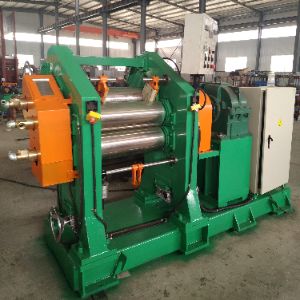
Calendering lines demand structural integrity that tolerates relentless vibration, thermal expansion, and high-tension nip loads without drifting out of alignment. Heavy-duty frames built for this purpose start with stress-relieved, normalized steel weldments—not light-gauge fabrications—so the roll stack remains rigid across shifts that never pause. Key joints are machined after welding, then bolted with tension-controlled fasteners to preserve geometric repeatability even when rolls are changed under production pressure.
Unlike modular press frames designed for occasional overloads, these structures incorporate deep side housings and cross-tied base plates that distribute forces evenly into the foundation. Bearing chocks slide on hardened, replaceable wear strips rather than directly against the frame, extending service intervals and simplifying maintenance. Thermal growth is managed through strategically placed expansion gaps and preloaded tie rods that hold roll parallelism within a few microns, ensuring gauge consistency across the full web width.
The payoff shows up in reduced downtime and fewer rejected coils: a frame that resists micro-yielding keeps roll gaps stable, which directly translates into tighter thickness tolerances and fewer adjustments. When every minute of calendering counts, investing in heavyweight construction pays for itself by eliminating the slow drift toward edge cracking and surface defects that lighter equipment quietly invites.
Custom Roll Configurations for Specialty Polymers
Specialty polymers rarely behave like commodity resins. A fluoroelastomer that sticks to chrome at 350°F, a liquid crystal polymer that freezes mid-web, or a conductive compound that abrades standard steel—each one forces you to rethink the roll stack. The off-the-shelf configuration gets you close, but the last fifteen percent of performance almost always lives in the roll diameters, surface finishes, internal cooling circuits, and the exact gap profile you run. Our approach starts with the polymer's thermal and rheological fingerprint, then works backward to a roll setup that keeps the material in its process window from the first nip to the final wind.
In practice, that means specifying things like spiral baffles cut deeper than standard for fast heat removal on thin-gauge fluoropolymer films, or a mirror-polished hard chrome face paired with a matte backup roll to control release without dragging the web. For shear-sensitive grades, we might step the roll diameters to progressively reduce line speed differential, or add individually driven rolls to fine-tune draw. Surface energy matters just as much: a plasma-etched ceramic coating on the center roll can hold a low-viscosity PEEK melt without building static, while a micro-textured Teflon sleeve on the exit roll prevents picking on tacky TPEs. Each choice is tied to a measured failure mode, not a catalog recommendation.
The payoff comes in scrap rate and uptime. A well-matched roll configuration can cut edge bead buildup by half on a filled polyamide line, or let you run a 40% calcium carbonate-loaded PP without chatter at 280 meters per minute. We've also retrofitted existing calenders with intermediate rolls and adjustable crossing to flatten gauge variation to under ±2 microns on optical-grade silicone. The key is treating the roll stack as a dynamic system—every material movement, temperature gradient, and release point is an input, not an afterthought.
Export Documentation Handled Before the Machine Leaves the Floor
Every shipment carries a full set of export records that are checked, stamped, and packed before the equipment is moved from the production area. This includes the commercial invoice, packing list, certificate of origin, and any buyer-specific certificates or test reports. The team verifies serial numbers, dimensions, and weights against the actual machine to avoid discrepancies during customs clearance.
Once the physical inspection is done, the paperwork is placed in a weatherproof document holder attached to the crate. A copy is also sent digitally to the freight forwarder and the client. This step prevents delays at the port and ensures the receiving side has everything needed for smooth unloading and installation.
Any last-minute changes, such as a revised Incoterm or an added safety declaration, are reflected in the documents before the machine leaves the shop floor. Nothing is left for the loading crew or the driver to handle. This approach keeps the export process transparent and reduces the risk of rejected entries or storage charges.
On-Site Commissioning and Operator Training That Cut Downtime
Commissioning on site rarely goes by the manual. Voltage levels drift, grounding issues surface, and the way a machine behaves under real loads differs from the factory test bench. Our engineers stay through those first critical hours, adjusting parameters, tightening connections, and watching how the system responds to actual production demands. That hands-on phase catches small faults before they become emergency stops.
Training operators is not about memorizing button sequences. We walk your team through realistic fault scenarios, show them what early warning signs look like on the display, and let them practice the right response under supervision. When operators understand the logic behind alarms and can distinguish a nuisance trip from a genuine fault, they stop problems at the source instead of waiting for a full shutdown.
The result is a shorter gap between installation and full-capacity output. Equipment runs within its intended parameters from day one, and your people keep it there. Downtime drops not because of luck, but because commissioning and training remove the usual startup surprises.
Material Feeding and Winding Integration Without Bottlenecks
In high-speed converting lines, material feeding and winding are often treated as separate problems, but that mindset creates hidden bottlenecks. A tightly integrated system synchronizes unwind tension, splice timing, and winder speed profiles so the web never waits for a sluggish feeder or an over-torqued spindle. Instead of patching individual stations, the whole path is tuned as one continuous loop.
The real bottleneck usually appears at transitions—roll changes, splices, or tension spikes during acceleration. By linking accumulator capacity directly to winder deceleration curves, operators can run nonstop across splices without overspeeding the line or creating slack. This approach eliminates the "feeder fast, winder slow" mismatch that forces unnecessary downtime.
On the shop floor, that integration shows up as fewer manual adjustments and predictable roll quality. Operators don't have to babysit a dancer roller or override a drive fault because the control logic coordinates feed rates, core torque, and lay-on pressure from a single reference. The result is a line that runs at planning speed, not at the speed of its weakest link.
FAQ
The exporter matches your production requirements—material type, width, thickness range, and output speed—with a calender that fits. Beyond shipping, they usually coordinate installation support, operator training, and spare parts, so you're not left dealing with a crate and a manual.
Features like servo-driven roll gap control, automated crowning compensation, and thermal profiling keep thickness deviations tight. That consistency means fewer quality rejects and less downtime for adjustments, which is what reliability really comes down to on a busy line.
Rubber processing, PVC film and sheet production, textile coating, paper finishing, and some composite material lines all use calenders. Each has different roll configurations and temperature needs, so exporters with cross-industry experience can steer you toward the right setup.
Check whether they ask detailed questions about your material blend, line speed, and existing upstream/downstream equipment. A strong exporter offers engineering review, not just a catalog pick. Also look for transparent lead times, accessible spare parts, and references from lines similar to yours.
Yes. Roll count, roll surface finish, heating method, drive power, and safety guarding can all be adapted. A capable exporter will review your floor plan and process data before proposing changes, so the calender integrates without forcing a costly rebuild of your whole line.
Look for remote diagnostics, scheduled maintenance kits, and rapid availability of wear parts like bearings and seals. Some exporters also offer periodic alignment checks or training refreshers. That ongoing relationship matters more than the initial price tag when a line runs around the clock.
It depends on customization and destination, but a realistic window from order confirmation to production handover is usually four to eight months. Heavy roll assemblies and precision alignment take time to build and test. A reputable exporter will give you a phased timeline instead of a vague promise.
Conclusion
Achieving uniform gauge and surface quality in continuous processing hinges on calender rolls that hold temperature within tight limits across the entire working width. Our machines pair precision thermal control with reinforced frames engineered to absorb constant mechanical stress, so a line producing technical films or specialty polymers can run around the clock without the frame flex that leads to edge variation. Roll arrangements are configured around each polymer family—whether the target is high-clarity sheet, filled compounds, or heat-sensitive formulations—rather than forcing a standard layout onto a process that demands otherwise. This approach avoids the trial-and-error adjustments that erode output during the first weeks of production.
Export logistics rarely make headlines until a machine sits idle on a dock. We prepare full documentation, including compliance certificates, packing lists, and installation drawings, before the calender leaves our floor, which removes the usual cross-border friction. Once on site, our commissioning team aligns rolls, verifies heating and drive behavior under load, and trains operators using the customer’s own materials, not generic demonstrations. Feeding accumulators and winding stations are integrated with speed-matching logic so the calender never waits on material handling. Every interface between feeding, calendering, and winding is tuned during installation, not left for the customer to resolve. The result is a line that reaches stable output faster and keeps running with fewer unplanned stops.
Contact Us
Contact Person: Chen Zhengwei
Email: [email protected]
Tel/WhatsApp: +86-13963975727
Website: https://www.sfcrubbermachine.com